
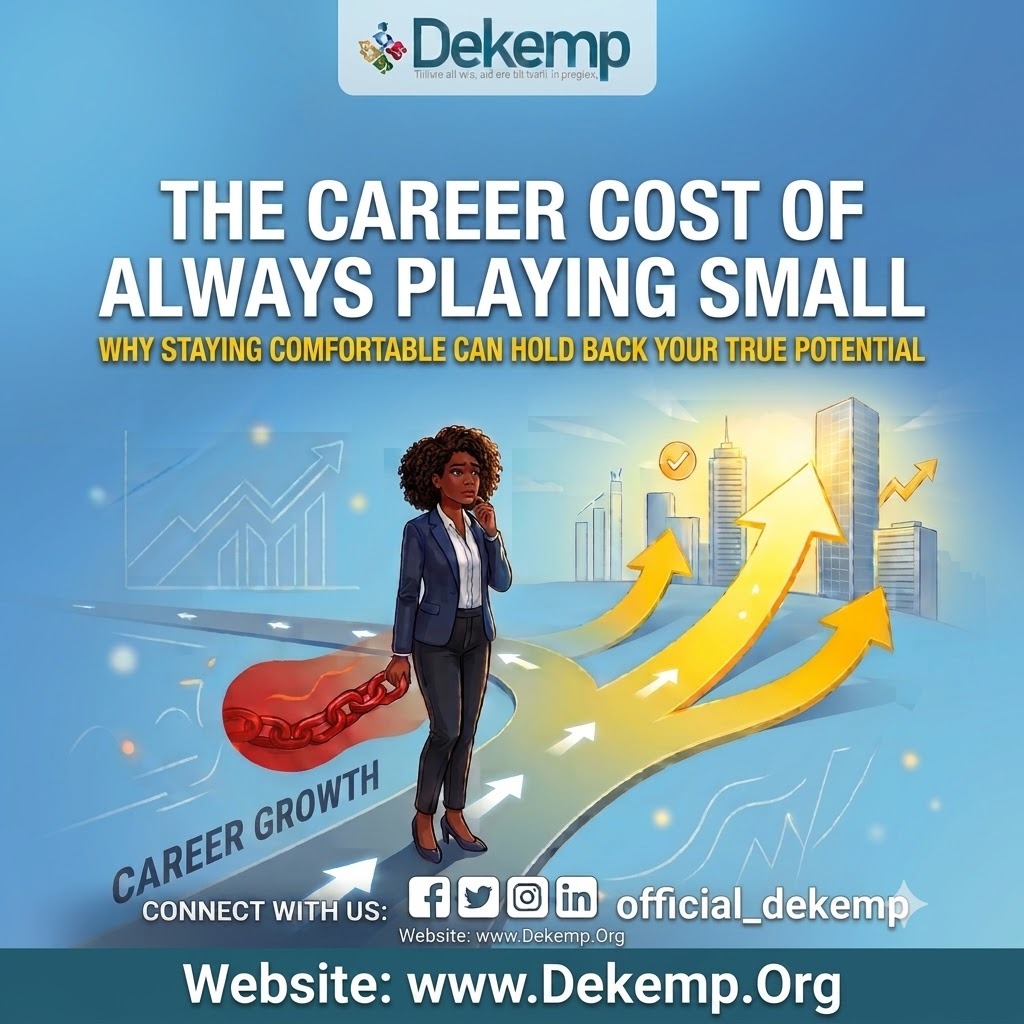
Dream big. Do not make the mistake of reducing your dreams to the size of your current circumstances. Learn to play the long game, and above all, remain consistent.
This is not one of those motivational talks where you are told to believe in yourself, and everything will magically fall into place. It is a reality I have observed in people around me and in society. There are people who work like elephants but think like ants. They put in enormous effort, yet their thinking remains confined to their immediate circumstances. Then there are those who may be working in seemingly small positions but think like elephants. They understand their value and refuse to allow their current position, location or situation to define the limits of what they can become.
The difference is often not in where they are at the moment, but in how they see where they are going.
You can be put down or belittled in your workplace. You can remain in a role that appears insignificant, or you may find yourself in a situation where other people have already decided what they think you are capable of becoming. But at some point, you have to decide whether you will accept those limitations or deliberately work your way beyond them.
Consider Jane.
Jane is a devoted receptionist who secured a job in an oil and gas company after her graduate studies. Like many young graduates, she was grateful for the opportunity because getting a job was already an achievement in itself. One of her responsibilities was to keep records of invitations and visitors to the company. She did this diligently for a year or two until she became very good at the job. She knew what was expected of her, understood the processes and could perform her duties almost effortlessly.
Then she noticed something important: she had mastered the role, but there was little else to learn from it.
Instead of becoming completely comfortable, Jane began to ask herself how she could become more valuable. She enrolled in an MBA programme and took networking seriously, both within her workplace and in her academic environment. She began to build relationships, acquire new knowledge and develop skills that went beyond her current job description.
Eventually, she completed her degree. The additional knowledge, relationships and capacity she had built positioned her for more demanding and strategic responsibilities. She continued developing herself and eventually became an executive trainee.
Now consider Janet, one of Jane’s colleagues who started at about the same time and in the same role.
Janet was also hardworking. She became very good at her job and, like Jane, mastered the responsibilities of a receptionist. The difference was that Janet became comfortable with what she had already achieved. Her primary concern became earning a higher salary, and while there is absolutely nothing wrong with wanting better pay, the problem was that the bigger paycheck became the extent of her ambition.
She stopped asking herself what else she could learn, what other responsibilities she could take on or what skills would make her more relevant in the future.
Eventually, the company’s needs changed. The organisation no longer had as much need for a receptionist, but there was a growing demand for someone who could function as a business administrator and handle more integral aspects of the business while also taking care of some of the responsibilities previously assigned to the receptionist.
Janet was suddenly at a disadvantage.
It was not necessarily because she did not have an MBA like Jane. The real problem was that she had stopped developing. She had mastered a role but failed to develop herself beyond the role.
This is one of the realities of an ever-changing world. The knowledge and skills that make you valuable today may not be enough to keep you valuable tomorrow. In an age where knowledge is increasingly important, deliberately refusing to learn, adapt and improve can come at a significant cost. Organisations change, industries evolve, technology changes the way work is done, and new opportunities often require capacities that did not previously exist.
This brings me to the question of what it really means to play the long game.
Playing the long game requires vision. It means being able to look beyond your immediate circumstances and make decisions based on where you want to be, rather than only on where you are. It does not mean that the short game is necessarily bad. In fact, there are times when you need to play the short game, but the short game should not come at the expense of your long-term vision.
Take Jane, for instance. While pursuing her MBA, she may need more money to support herself and achieve her goals. There is nothing wrong with wanting a better paycheck or accepting an opportunity that improves her financial situation. The difference is that the higher income is not the final destination. It is one of the things that supports the larger vision she has for herself.
Jane is therefore not controlled by her current position. Her vision determines how she responds to her current position.
This is what it means to understand the difference between playing the short game and playing the long game. Sometimes you need the short-term win, but you should not become so consumed by it that you lose sight of the bigger picture.
There are people who will only believe in you when they see the results. There are people who will define you by the job you currently have, the amount of money you currently earn, the size of your business, the place you live or even the mistakes you have made. If you allow their assessment of you to become your own assessment of yourself, you may unconsciously begin to live within limitations that were never yours to begin with.
Your current position is not necessarily a reflection of your final destination.
You may be starting small, but you do not have to think small. You may be in an entry-level position today, but that does not mean you should stop preparing for leadership. You may be running a small business today, but you can begin building the knowledge, systems and relationships required for the larger business you hope to have tomorrow.
The important thing is to keep developing your capacity.
Learn. Network. Ask questions. Take on responsibilities that stretch you. Read. Acquire new skills. Become curious about what happens beyond your current role. Do not wait until an opportunity appears before you begin preparing for it.
Like Jane, learn to move with a sense of vision rather than with the limitations created by other people’s perception of you. Know that where you are today may simply be one part of the journey.
And then, be consistent.
Sometimes success does not come from one extraordinary decision. It comes from the quiet accumulation of small decisions made repeatedly over time. It comes from continuing to learn when nobody is watching, preparing when there is no immediate reward and showing up even when the results are not yet visible.
Play the long game. Use the short game when necessary, but never lose sight of the larger vision.
Keep building your capacity. Keep showing up. Keep becoming.
Eventually, the person you are becoming will meet the opportunities you have been preparing for.
Till we all win, we are all a work in progress.
Ochuko Blossom


0 Comments